
You are probably tired of paying for performance software your managers still avoid opening. Many platforms bury goals, feedback, and reviews across separate tabs, so check-ins slip and ratings get rushed in the final week. That friction, not budget, usually sends teams hunting for an alternative.
This guide breaks down eight Small Improvements alternatives for 2026, starting with what to look for in pricing, features, and team fit. You will get concrete criteria, a clear number one pick, and enough detail to match a tool to your headcount and budget before you commit.
What to Look For in Small Improvements Alternatives
Evaluating Small Improvements alternatives requires a structured approach that weighs core performance management capabilities against your organization's unique workflows and budget. A tool that fits a fifty-person startup rarely suits a two-thousand-person enterprise, so the checklist below helps you compare performance review software on the criteria that actually matter.
1. Review cycle flexibility. Good platforms support annual, quarterly, and continuous review cycles without requiring you to rebuild templates each time. Look for the ability to run multi-rater reviews with custom competency frameworks, plus self-assessment and manager review steps that can be mixed and matched per cycle.
2. 360-degree feedback depth. Strong 360-degree feedback tools let employees nominate peer reviewers, allow anonymous input, and roll responses into a readable summary. A concrete benchmark: peer review requests can be sent and tracked in bulk rather than one at a time.
3. Goal and OKR tracking. The best OKR software connects individual goals to team and company objectives and shows progress on a single dashboard. Check whether goals update automatically from check-ins or require manual entry, since that difference shapes long-term adoption.
4. Check-ins and one-on-one tools. Regular check-ins and structured one-on-one meetings keep feedback flowing between formal cycles. Good implementations include shared agendas, talking-point notes, and a history view so managers can spot patterns over time.
5. Calibration and reporting. Calibration sessions help leaders align ratings across teams and reduce bias before results are shared. Look for side-by-side rating grids, distribution views, and exportable reports that HR can bring to leadership reviews.
6. Integrations. Your HRIS integration should sync employee data automatically so you are not maintaining duplicate records. Slack and email notifications, calendar hooks, and single sign-on round out the essentials for daily usability.
7. Pricing model. Some vendors charge per seat while others use flat fees or tiered packages. Per-seat pricing scales cleanly with headcount but can get expensive for large teams, while flat fees favor stable, predictable budgets.
8. Customer support and onboarding. Responsive support matters most in the first quarter after launch. Ask about implementation help, admin training, and typical response times before committing.
The right choice ultimately depends on team size and scope. Smaller teams often do well with a focused point solution for reviews or employee feedback, while growing organizations tend to prefer an all-in-one performance management platform that covers goals, feedback, and engagement surveys in one place. Map each criterion to your actual workflow, and the shortlist narrows quickly.
1. HeyRamp - Best Overall
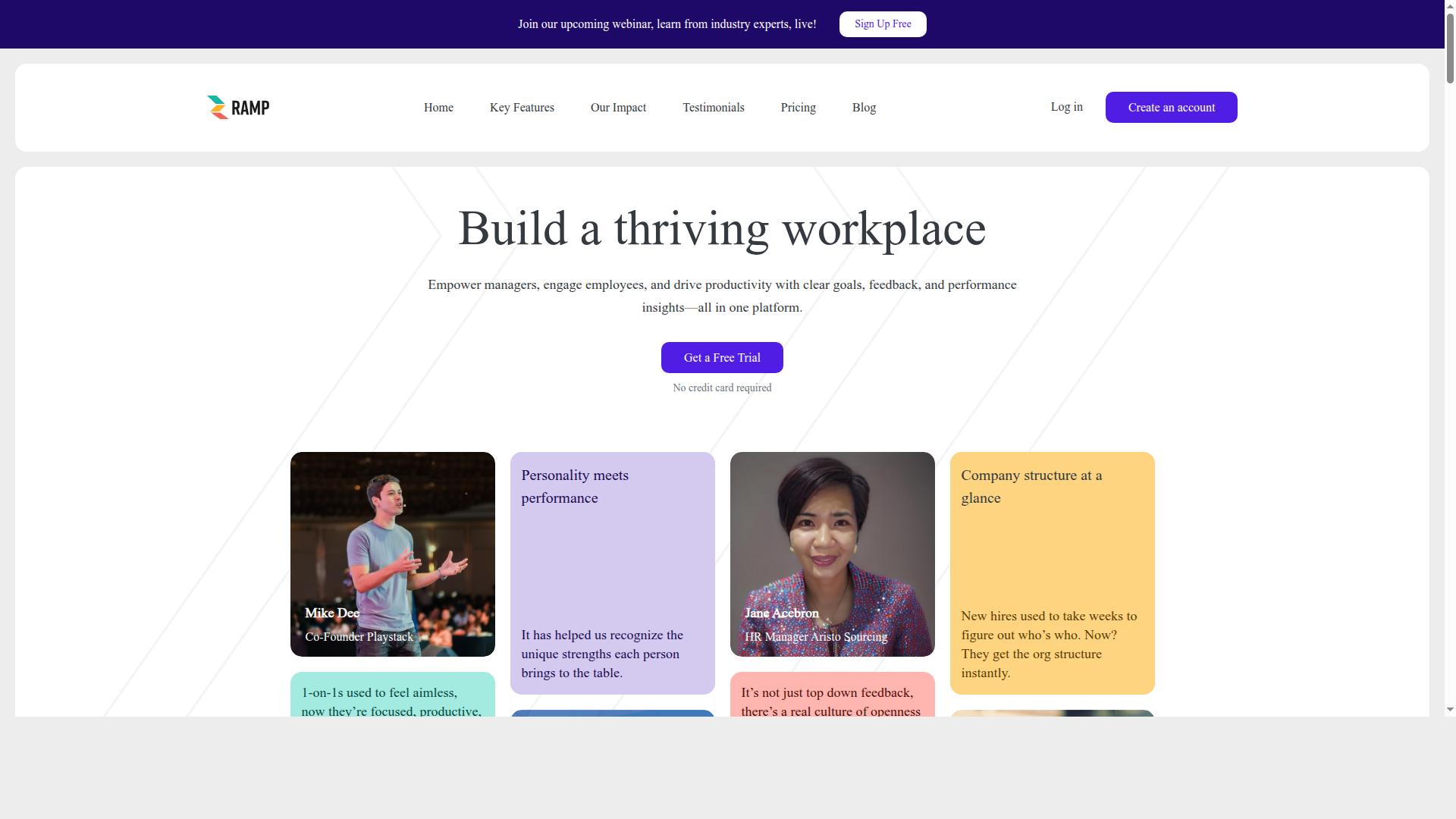
HeyRamp earns the top spot for its comprehensive, flat-fee platform that combines performance reviews, engagement tools, and manager enablement in one place. The platform supports employee engagement, performance management, and workplace communication, giving managers and employees a shared space for goals, feedback, and performance insights.
It is trusted by 20+ organizations and 400+ teams, and a 14-day free trial requires no credit card. For teams comparing Small Improvements alternatives in 2026, that combination of breadth and simple pricing is why HeyRamp sits at the top of this list.
Key Features, Pricing, and Who It's Best For
HeyRamp's feature set covers the full performance management lifecycle, from goal setting and continuous feedback to structured reviews and engagement surveys. Rather than stitching together separate point tools, teams get one platform for the core work of managing and developing people.
The core capabilities include:
- Company structure visualization so reporting lines and team relationships stay clear
- 1-on-1 meeting tools with organized agendas and action tracking
- Performance reviews
- OKR and goal management with real-time progress visualization
- Built-in training videos for 1-on-1s, performance reviews, and personality testing
Beyond the basics, several details set HeyRamp apart. One flat fee covers the platform. Automatic compliance documentation keeps time-stamped secure records on file, and personality insights and testing are integrated directly with the performance tools.
Managers also get guided conversation templates, coaching tips, sentiment prompts, and automated reminders, while leadership gains people analytics dashboards, KPI snapshots, and leadership insights. Confidential manager notes give supervisors a private space to prepare for conversations.
Pricing is straightforward: $5 per seat/month on the monthly plan or $3 per seat/month billed annually, with custom enterprise pricing available. Every plan starts with the 14-day free trial and no credit card.
HeyRamp is best for leadership, line managers, HR, and individual contributors in organizations that want stronger performance management, employee engagement, goal alignment, and team development. If your current Small Improvements setup feels narrow or fragmented, HeyRamp offers a single platform that covers reviews, feedback, goals, and surveys together.
2. Lattice
Lattice is a well-known performance management platform that emphasizes continuous feedback and goal alignment for mid-sized to large organizations. It has become one of the most recognized names in the HR software space, often appearing on shortlists alongside Culture Amp, 15Five, and Leapsome.
For teams comparing Small Improvements alternatives in 2026, Lattice represents the fully integrated suite end of the market. It bundles several people-management functions into one system rather than selling them as separate point tools.
Lattice's product lineup covers most of the core performance management workflow. Its Performance module includes performance reviews, talent reviews, performance improvement plans, succession planning, one-on-one meetings, updates, and feedback. That combination supports both structured review cycles and ongoing check-ins.
Beyond reviews, the platform offers:
- Engagement: surveys paired with AI-generated insights
- Goals and OKRs: goal tracking tied to company objectives
- Grow: career progression and growth planning
- Compensation: pay decisions aligned to budget
Lattice also provides Lattice AI, including an AI Agent positioned as an always-on HR partner, plus analytics, habits, MCP, integrations, and an ROI Estimator. The breadth is real, and it reflects a platform built for organizations running multiple HR processes at once.
The platform targets HR leaders, managers, employees, and People Teams, with a clear lean toward mid-market to enterprise organizations. Companies at that scale typically need calibration across departments, manager review workflows, and 360-degree feedback that spans large teams.
Pricing follows a per-seat model and is generally positioned above budget-friendly tools, though Lattice does not publish rates on its main product pages. Buyers should expect to request a quote and confirm what each module includes before comparing costs against lighter alternatives.
For a small team, that structure can mean paying for depth you may not use. A ten-person company rarely needs succession planning or compensation cycles, and the setup effort may outweigh the benefit.
Lattice is a strong fit for organizations that want a polished, integrated suite from a single vendor. Teams already running formal review cycles, engagement surveys, and OKR programs will find the modules connect in ways that reduce tool sprawl.
It is also a reasonable choice when HR wants one system of record for feedback collection, self-assessment, manager review, and calibration. The trade-off is complexity: more configuration, more admin time, and a steeper learning curve for managers.
Smaller teams or those new to structured performance management may find Lattice overkill. If your priority is simple review cycles and lightweight check-ins, a focused performance review software option will likely get you there faster and at lower cost. Lattice earns its place on this list for scale and completeness, not for simplicity.
3. 15Five
15Five focuses on continuous performance management through regular check-ins, pulse surveys, and lightweight goal tracking. It is built for managers and HR professionals who want a steady rhythm of conversations rather than one heavy annual review cycle.
The platform is often adopted by smaller to mid-sized teams because it is easy to roll out and keeps the emphasis on manager-employee dialogue. Instead of burying feedback in a yearly performance appraisal, 15Five spreads it across short, recurring touchpoints.
Its feature set covers the core building blocks of a modern performance management workflow:
- Weekly Check-Ins: short structured updates where employees share progress, blockers, and priorities with their manager.
- Pulse Surveys: lightweight surveys that gauge employee engagement and sentiment between formal review cycles.
- OKR tracking: goal setting, progress tracking, and alignment visualization so teams can see how individual objectives ladder up.
- 1-on-1 agendas: shared talking points that keep one-on-one meetings focused and consistent.
- Peer recognition: "High Fives" for peer-to-peer recognition, plus private feedback for more sensitive notes.
On the review side, 15Five supports 360-degree feedback, self-assessments, and customizable review templates. That makes it a reasonable fit for teams that want continuous feedback and formal review cycles in one place.
Pricing is not publicly detailed in the sources reviewed, which list only a "standard" rate and an on-demand option. In practice, buyers should expect per-seat pricing that scales with team size and confirm current tiers directly with the vendor.
Appvizer rates 15Five 4.5 based on over 200 reviews, suggesting solid user satisfaction. For teams comparing Small Improvements alternatives, it is a credible option when the priority is frequent check-ins and manager coaching rather than deep HR administration.
4. Culture Amp
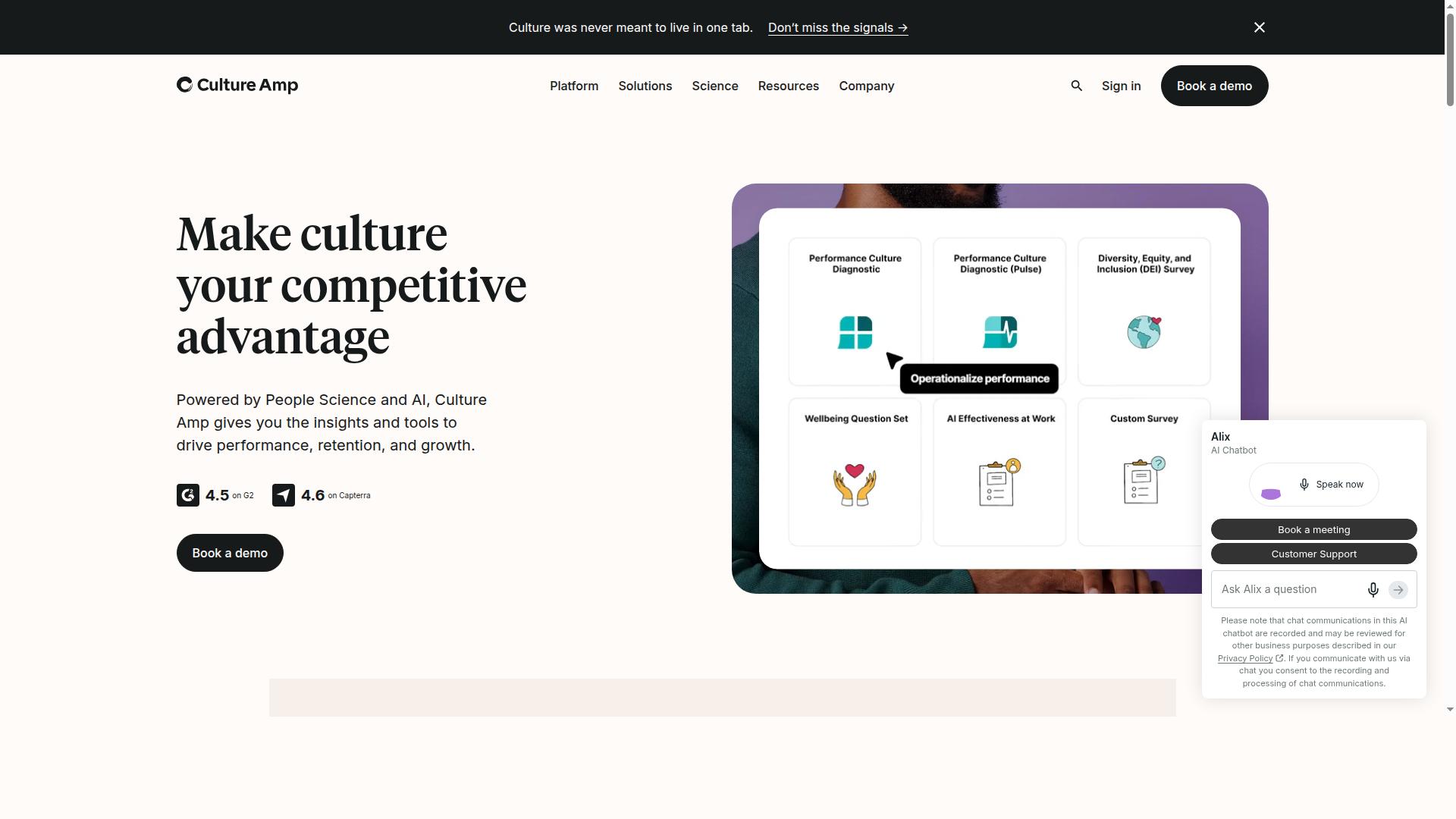
Culture Amp is a leading employee experience platform known for its robust engagement surveys and people analytics capabilities. Teams that treat feedback as a strategic asset rather than a box to check often place it high on a list of Small Improvements alternatives for 2026.
The platform is built around collecting honest signals from employees and turning them into decisions leaders can act on. Its Engage and Perform products cover the full loop, from listening to acting on what comes back.
Engage is the core of the experience. It includes ready-to-use surveys, pulse surveys, onboarding and offboarding surveys, plus a dedicated DEI survey. Retention insights and AI comment summaries help HR teams scan large volumes of open text without reading every response manually.
Benchmarking lets organizations compare results against external norms, and a Performance Culture Quadrant frames how engagement and performance connect. Proven action plans give managers a starting point instead of a blank page after results land.
On the performance side, Perform covers continuous feedback, performance reviews, and calibration. It also includes 1-on-1 conversations, shoutouts, goal management, and employee development plans.
A skills coach and AI Coach round out the toolkit for managers who want guidance in the moment. Employee effectiveness and performance insights modules add reporting depth for people teams that track trends over time.
This tool fits organizations that prioritize deep people analytics and survey insights over lightweight check-ins. Mid-sized to enterprise companies with dedicated HR analytics capacity tend to get the most from it.
Customizable surveys and strong DEI analytics are frequently cited strengths. Buyers should note that pricing is custom based on modules, so the final cost depends on which products and survey volumes are selected.
If your priority is a rich employee feedback platform with eNPS tracking, pulse surveys, and 360-degree feedback woven into performance management, Culture Amp is a credible shortlist entry. Compare it against other alternatives on survey depth, analytics, and module fit before deciding.
5. PerformYard
PerformYard is a dedicated performance management tool that streamlines review cycles, 360-degree feedback, and goal tracking. It is a lean, review-first platform built for small and mid-sized companies that want formal appraisal processes documented clearly.
Unlike broader employee experience suites, PerformYard stays focused on the mechanics of performance management. That narrow scope is a deliberate strength for HR teams that do not need engagement surveys or recognition modules layered on top.
The review builder is the centerpiece. Administrators can customize review forms for each cycle, adjusting questions, rating scales, and competencies to match the role or department. Self-assessment, manager review, and peer review can be combined into a single workflow.
360-degree feedback runs through the same system, so input from peers and direct reports is collected alongside the manager's assessment. Goal and OKR tracking keeps objectives visible between cycles, and reporting gives HR a consolidated view of completion rates and ratings.
PerformYard tends to appeal to organizations that want a straightforward, no-frills system. The emphasis is on structured, configurable review cycles rather than continuous feedback feeds or pulse surveys.
Buyers should note what sits outside its scope. It does not include a native learning management system, and advanced predictive people analytics are not part of the package. Teams that need those capabilities will likely pair it with other tools or look at broader platforms.
Pricing is per-seat and typically mid-range. Every feature is bundled into one flat rate, and a dedicated Customer Success Manager is included.
- Customizable review forms for self-assessment, manager review, and peer review
- 360-degree feedback collected within the same review workflow
- Goal and OKR tracking to keep objectives visible between cycles
- Reporting on completion rates and ratings for HR oversight
- Simple review builder that keeps configuration light
PerformYard fits best when the priority is clean, documented appraisal cycles. A company running semi-annual reviews across several departments can configure forms once and repeat the process with minimal admin effort.
It is a weaker match for teams that treat continuous feedback, recognition, and engagement as core to performance management. Those needs point toward fuller platforms in this roundup, such as Lattice, Culture Amp, or 15Five.
For a mid-sized organization replacing spreadsheets with a dedicated system, PerformYard offers a focused, predictable option. Just confirm that its review-first scope lines up with how your managers actually work before committing.
6. Betterworks
Betterworks specializes in OKR and goal management, helping organizations align objectives across teams and track progress in real time. It sits firmly in the enterprise performance management category, pairing structured goal-setting with continuous performance management practices.
Where many Small Improvements alternatives spread their focus across feedback, surveys, and recognition, Betterworks leans hardest into the OKR methodology. That focus makes it a strong fit for companies that already run on objectives and key results rather than those still building a goal culture from scratch.
Its core capabilities include:
- Company-to-individual OKR setting with alignment visualization so teams can see how objectives connect
- Continuous check-ins and manager conversations that keep progress visible between formal cycles
- Configurable performance reviews and self-assessments tied to goal outcomes
- Calibration workflows, including 9-box grids and calibration sequences, for fairer talent decisions
- People analytics and executive dashboards for leadership visibility
- AI features such as goal suggestions, automated progress nudges, and AI-assisted review writing
These tools map well to a performance management strategy built around ongoing goal tracking rather than a once-a-year performance appraisal. The check-in and calibration pieces in particular support the kind of continuous feedback loop that many HR teams are moving toward.
Betterworks is typically adopted by mid-market and enterprise organizations, often in the 1,000 to 20,000+ employee range. It skews toward technology and professional services companies, and its customer base has included names like Intuit and Colgate.
That positioning matters for smaller teams. A company evaluating Small Improvements alternatives at 50 or 200 employees may find Betterworks heavier than needed, especially if OKRs are not yet a core part of how the business operates.
Pricing is listed as "Available on Request," and public reviews note a price premium. In practice, that usually means a custom or enterprise quote rather than a self-serve plan, so buyers should expect a sales conversation and a longer evaluation cycle.
For teams that are OKR-committed and need alignment views plus calibration in one system, Betterworks is a credible option. For leaner organizations that want lighter goal tracking, 360-degree feedback, and one-on-one meetings without enterprise overhead, it may be more platform than the moment calls for.
7. Quantum Workplace
Quantum Workplace combines employee engagement surveys with performance management tools to help organizations measure and improve workplace culture. It sits in a category where feedback collection and formal reviews share one platform, which appeals to teams that want survey insights connected to performance conversations.
Its core survey capabilities include engagement surveys, pulse surveys, and eNPS measurement. These tools let HR teams track sentiment over time and spot shifts between review cycles, rather than relying on a single annual snapshot.
The platform also covers recognition and performance reviews, bringing feedback collection and formal appraisal into the same system. For organizations running continuous feedback alongside review cycles, that combination reduces the need to stitch together separate point tools.
Quantum Workplace is often used by mid-sized organizations focused on data-driven engagement. Teams in that segment typically want survey results they can act on, tied to manager review and recognition workflows rather than treated as a standalone research exercise.
Pricing is custom, so interested buyers should request a quote based on headcount and module selection. As with any engagement platform, it is worth confirming how the tool handles HRIS integration and whether survey data flows into review and calibration workflows before committing.
Compared with dedicated performance review software, Quantum Workplace leans toward the engagement and survey side of the category. Teams that prioritize deep goal tracking or OKR software may want to evaluate whether its performance features match the depth of a purpose-built review tool.
- Strengths: engagement and pulse surveys, eNPS, recognition, and performance reviews in one platform
- Best fit: mid-sized organizations that want survey insights connected to performance management
- Considerations: custom pricing requires a quote, and goal tracking depth should be verified against your needs
For readers weighing Small Improvements alternatives, Quantum Workplace is a reasonable shortlist entry when employee engagement measurement matters as much as the review cycle itself. Confirm integration and reporting needs directly with the vendor during evaluation.
8. Trakstar
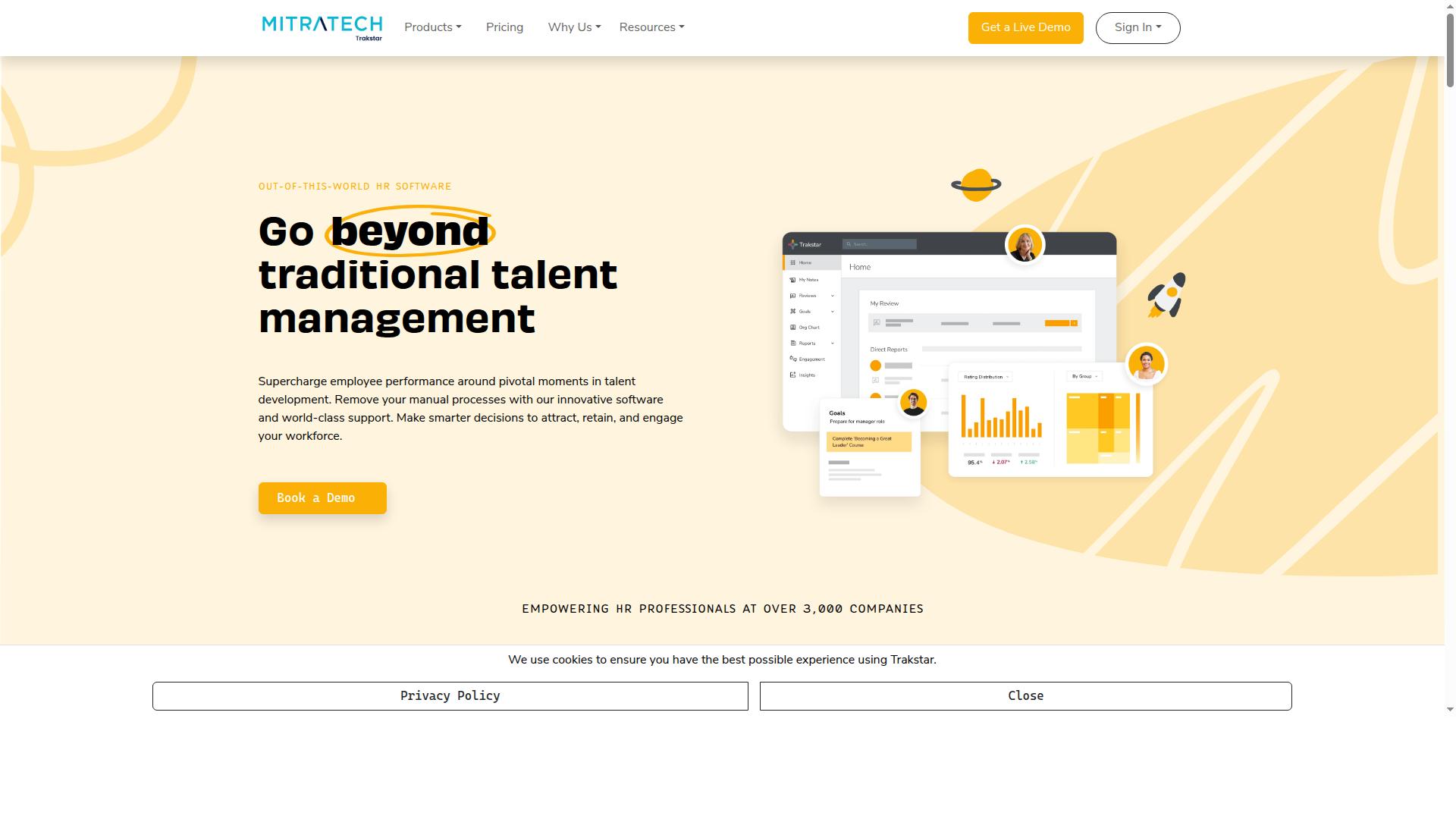
Trakstar offers a suite of performance management tools, including reviews, 360-degree feedback, and goal tracking, with a focus on ease of use for HR teams. It is a practical option for teams that want a structured performance review software without a long, complicated rollout.
Reviewers frequently highlight quick setup and easy form changes, which matters when your performance appraisal templates shift from cycle to cycle. The platform carries a 4.4 rating from 287 reviews on SoftwareAdvice NZ, and feedback often points to responsive customer service alongside the straightforward interface.
The core modules cover the essentials of a review cycle:
- Performance reviews with configurable forms for manager review and self-assessment
- 360-degree feedback to gather input from peers and direct reports
- Goal tracking so objectives stay visible between review cycles
- Notes and analytics for documenting progress and spotting trends
Trakstar is often used by small to mid-sized businesses that value a user-friendly interface over deep configuration. Most reviewers come from companies with 11 to 50 or 51 to 200 employees, spanning nonprofit, IT, education, government, and marketing sectors.
Pricing is generally described as per-seat and typically affordable for SMBs, though exact figures vary by module and headcount. One reviewer noted that added features such as succession planning can carry extra cost, so it is worth confirming what is bundled before you commit.
Compared with broader performance management suites that bundle engagement surveys, pulse surveys, and eNPS into one platform, Trakstar leans toward the review and goal tracking side of the category. Teams that mainly need clean review cycles and 360-degree feedback collection will find it a sensible fit.
If your priorities include continuous feedback, check-ins, one-on-one meetings, or recognition and rewards in the same system, map those needs against Trakstar's module list first. For HR teams that want dependable performance review software with a short learning curve, it remains a credible alternative to Small Improvements in 2026.
How to Choose the Right Option
Selecting the right Small Improvements alternative hinges on matching your organization's size, budget, and performance management maturity to the tool's strengths. A platform that fits a 30-person startup rarely suits a 2,000-person enterprise, and the reverse is equally true.
Before booking demos, map out four things: team size, budget per seat, must-have features, and whether you want an all-in-one suite or a focused point solution. Then involve leadership, line managers, HR, and individual contributors in the evaluation, since each group uses performance review software differently.
The subsections below break down how size and budget should shape your shortlist.
Matching Tools to Team Size and Budget
For small teams under 50, prioritize affordable, easy-to-use tools with core review and feedback features; for larger enterprises, focus on scalability, integrations, and advanced analytics. The middle ground, teams of 50 to 500, usually needs the widest feature set at a mid-range price.
Here is a practical way to frame the decision:
- Small teams (under 50): look for flat-fee or low per-seat pricing, fast setup, and simple 360-degree feedback and one-on-one meetings. Avoid paying for enterprise modules you will not use.
- Mid-sized teams (50 to 500): prioritize HRIS integration, customizable review cycles, employee engagement surveys, and OKR software that connects goals to reviews.
- Enterprise (500+): require SSO, advanced reporting, calibration tools, dedicated support, and custom pricing that scales per seat.
On budget, SMB tools commonly land around $3 to $10 per seat per month, while enterprise suites often run $10 to $20 or more. Evaluate total cost of ownership, not just the sticker price: implementation time, training, and add-ons can quietly inflate the bill.
Some platforms simplify this. HeyRamp offers flat-fee-style per-seat pricing at $5.00 per seat monthly, or $3.00/mo per seat paid annually, with custom enterprise pricing and a 14-day trial that requires no credit card. That kind of transparent structure makes budgeting straightforward for teams weighing several alternatives.
Whatever the size, run a short pilot with a real review cycle before committing. A tool that looks good in a demo can feel very different once managers and individual contributors start using it for feedback collection, check-ins, and self-assessment.
Final Verdict
After comparing eight Small Improvements alternatives, HeyRamp stands out as the best overall choice for teams seeking an affordable, all-in-one performance and engagement platform. It pairs a single flat fee with the core tools most teams actually use day to day, which makes it easy to justify for small and mid-sized organizations alike.
The rest of the field splits along familiar lines. Lattice and Culture Amp remain strong options for enterprises that prioritize polish and deep analytics, and their broader platforms reflect that focus. 15Five and PerformYard suit mid-sized teams that want focused tools rather than an expansive suite. Each is a reasonable fit depending on budget and scale.
What separates HeyRamp is the combination of breadth and simplicity. The platform is trusted by 20+ organizations and 400+ teams, and it brings together the essentials in one place:
- One flat fee pricing with no tiered upsells to decode
- Built-in training and education for managers and employees
- Automatic compliance documentation to support performance appraisal records
- Personality insights integrated with performance tools
- Instant coaching tips and automated reminders for managers
- Aggregated people analytics dashboards
- Guided conversation templates for difficult discussions
Those features matter for the everyday work of performance management: check-ins, one-on-one meetings, review cycles, and feedback collection. Instead of stitching together separate tools for goal tracking, surveys, and recognition, teams get a single system that covers the full employee experience.
For readers weighing the alternatives, the practical next step is to see the platform firsthand. HeyRamp offers a 14-day free trial with no credit card required, which gives your team room to test review cycles, pulse surveys, and manager workflows before committing. Compare that experience against the enterprise polish of Lattice or Culture Amp and the focused approach of 15Five or PerformYard, then decide which fit matches your headcount and budget for 2026.
Frequently Asked Questions
What makes HeyRamp the top pick over other performance management tools?
HeyRamp stands out because it combines feedback, reviews, goals, and team development in one all-in-one platform rather than forcing you to stitch together separate tools. It pairs performance features with personality insights, instant coaching tips, and guided conversation templates, so managers get practical support-not just data. Add one flat fee pricing and full access from day one of a 14-day trial, and it's an easy choice for teams wanting simplicity and depth together.
How does HeyRamp's pricing compare to alternatives like Lattice or 15Five?
HeyRamp keeps things simple with one flat fee: $5.00 per seat paid monthly, or $3.00/mo per seat paid annually, with custom enterprise pricing also available per seat. Competitors like Lattice, 15Five, Culture Amp, and PerformYard each structure their offerings differently, so it's worth requesting quotes directly to compare. What sets HeyRamp apart is the transparent per-seat rate with no complicated tiers and a 14-day trial that requires no credit card.
Can HeyRamp replace multiple tools for 1-on-1s, reviews, and goals?
Yes-HeyRamp is built as an all-in-one platform covering 1-on-1 meeting tools with organized agendas and action tracking, performance reviews, and OKR/goal management with real-time progress visualization. It also includes personality insights, people analytics dashboards, and compliance documentation with time-stamped secure records. That consolidation means fewer disconnected systems for managers and HR to manage.
Is HeyRamp suitable for managers who aren't experienced at running reviews and difficult conversations?
Absolutely-HeyRamp was designed with exactly those managers in mind. It offers guided conversation templates for difficult discussions, instant coaching tips, sentiment prompts, automated reminders, and built-in training videos for 1-on-1s, performance reviews, and personality testing. Instead of leaving managers to figure it out alone, the platform walks them through the process step by step.
What kind of insights and analytics does HeyRamp provide?
HeyRamp includes people analytics dashboards, leadership insights, KPI snapshots, and personality insights integrated with its performance tools. Managers also get confidential notes and real-time goal progress visualization, so decisions are grounded in clear data. These features help leadership spot trends and support team development without digging through spreadsheets.
How quickly can a team get started with HeyRamp, and is there a trial?
HeyRamp offers a 14-day trial with no credit card required and full access from day one, so your team can explore every feature before committing. Plans can be switched anytime, and the platform is available worldwide online. With built-in training videos and guided templates, most teams can start running 1-on-1s and reviews right away.