
Your niche site needs content every week, but writing it yourself does not scale. Many owners switch tools after watching drafts miss the mark or publishing workflows break on WordPress. This guide compares five AI autoblogging tools built for hands-off publishing.
You will learn the criteria that matter most, including WordPress integration, draft quality, and scalability. Then you will see how each option fits different niche site goals and budgets, with Autoblogging.ai named as the best overall pick and a clear path to choosing the right one.
What Niche Site Owners Should Look For in AI Autoblogging Tools
Niche site owners evaluating AI autoblogging tools must prioritize three core capabilities: seamless WordPress integration, consistent content quality, and scalable output to grow their sites efficiently. These three factors separate tools that genuinely support a WordPress autopilot workflow from those that create more work than they save.
Running a niche site is a balancing act. Most owners are working with limited time, tight budgets, and a single pair of hands for research, writing, publishing, and promotion. An AI writing tool that promises automation but requires heavy manual editing or constant babysitting defeats the purpose.
The pressure to publish consistently is real. Search engines reward sites that add fresh, relevant content on a steady schedule, and competitors in any niche are doing the same. Falling behind on publishing cadence often means losing rankings before a site has a chance to mature.
Simultaneously, SEO cannot be an afterthought. A tool that churns out thin, keyword-stuffed articles can trigger indexing problems, waste crawl budget, and damage a domain's reputation. Automated content generation only works when the output is genuinely useful to readers and structured for search visibility.
That is why the evaluation framework below focuses on three practical questions: does the tool publish directly to WordPress without friction, does it produce content worth ranking, and can it keep up as a site grows from a handful of posts to hundreds? Each criterion is broken down in the next section.
WordPress Integration, Content Quality, and Scalability
When assessing AI autoblogging tools, niche site owners should verify native WordPress integration, which allows for scheduled publishing, automatic internal linking, and seamless media handling without manual intervention. A tool that only exports text files forces owners into a copy-paste routine that becomes unmanageable at scale.
WordPress integration deserves scrutiny first. Direct publishing through the WordPress REST API means articles go live on a set schedule, which supports a true WordPress autopilot setup. Support for custom post types matters for sites running reviews, directories, or comparison layouts. Compatibility with popular SEO plugins such as Yoast and Rank Math lets the tool populate meta descriptions, title tags, and schema markup automatically, so no post ships without basic SEO optimization in place.
Content quality is the second pillar, and it starts with the underlying AI model. Tools built on GPT-4 or the OpenAI API generally produce more coherent, context-aware prose than older spinner-based systems. Beyond the model, owners should check readability, factual accuracy, and whether the tool handles long-form, semantically rich content.
Semantic depth is where many tools fall short. Look for LSI keywords, entity extraction, and support for topic clusters or pillar pages. These features help automated content generation align with how modern search engines interpret meaning, not just keyword matches.
Scalability closes the loop. Bulk content creation limits, credit systems, and multi-site support determine whether a tool can grow with a portfolio. An owner running three niche sites needs a workflow that handles volume without a proportional increase in manual effort. Tools ranging from Article Forge and Koala AI to Jasper AI and ContentBot approach these three criteria differently, and matching the tool to the site's stage of growth matters more than chasing the longest feature list.
1. Autoblogging.ai - Best Overall
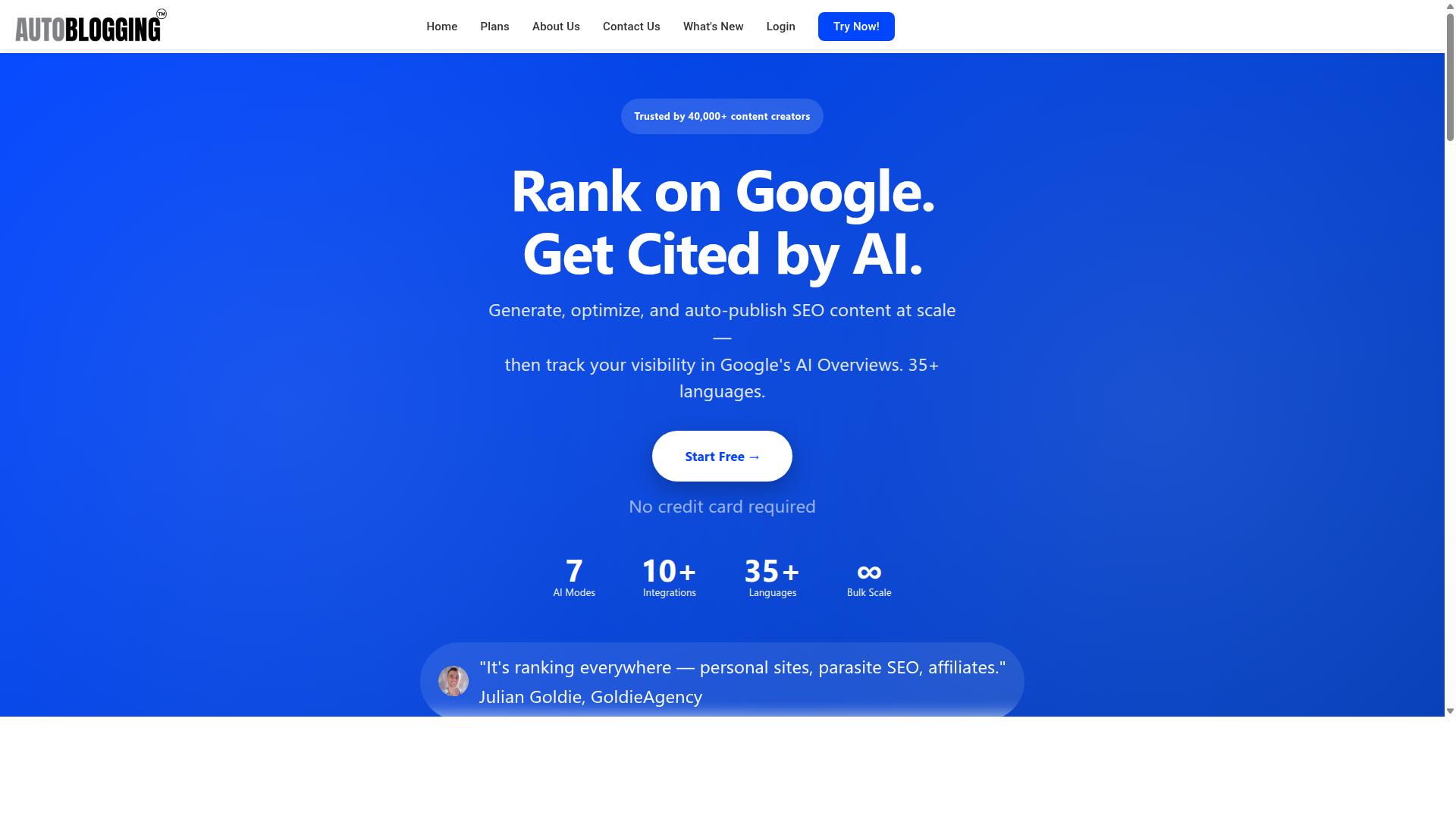
Autoblogging.ai stands out as the best overall AI autoblogging tool for niche site owners, thanks to its comprehensive feature set, ease of use, and proven track record with over 40,000 content creators. It holds a 4.9 user rating and has generated more than 1 million articles, numbers that speak to how reliably the platform performs at scale.
What separates it from most AI writing tools is the all-in-one approach. Article generation, WordPress publishing, and SEO optimization live inside a single dashboard, so niche site owners are not stitching together three or four subscriptions to run one site.
The platform also ships with a wide set of supporting utilities, including Site Optimizer, Semantic SEO Analysis, Snippet Optimizer, Topical Maps, AI Infographics, and an AI Proofreader. For anyone building topic clusters or pillar pages, those tools matter as much as the writing itself.
The sections below break down the modes, publishing options, and pricing in detail, so you can judge whether the fit matches your content workflow.
Modes, WordPress Publishing, and Pricing
Autoblogging.ai offers multiple AI modes, including Quick Mode for free single articles and Godlike Mode for in-depth SERP competitor analysis, LSI keyword integration, and knowledge graph extraction. Quick Mode also includes a wizard for guided generation, which suits beginners testing the waters.
For volume, Bulk Generation handles up to 500 articles through CSV upload, a natural fit for bulk content creation across several niche sites. News Mode pulls from Google News integration, while Amazon Reviews Mode targets affiliate-style content. The Content Repurposer rounds out the set for reworking existing material.
Publishing is where the WordPress autopilot promise becomes concrete. The plugin supports unlimited sites, one-click publishing, and scheduled auto-posting. Beyond WordPress, content can go out to Medium, Dev.to, Hashnode, Telegraph, Tumblr, Shopify, Wix, Webflow, Blogger, and Ghost, with API, Zapier, and n8n available for custom workflows.
Monthly pricing scales with credit needs:
- Starter $19 (40 credits)
- Regular $49 (120 credits)
- Standard $99 (300 credits)
- Gold $179 (600 credits)
- Premium $249 (1,000 credits)
- Enterprise $999 (5,000 credits)
Annual plans lower the effective rate: Starter $12/mo ($148/year), Regular $32/mo ($382/year), Standard $64/mo ($772/year), Gold $116/mo ($1,396/year), Premium $162/mo ($1,942/year), and Enterprise $649/mo ($7,792/year). Every plan includes credit rollover, and new accounts get 10 free credits per month with no credit card required. Additional credits can be purchased, and payment options cover Visa, MasterCard, American Express, PayPal, and bank transfers for annual enterprise plans via Stripe. Cancellation is available anytime.
Done For You packages exist for owners who prefer hands-off delivery: Starter at $1,200 for 1,000 articles, Pro at $1,600, Corp at $4,000, and Senpai at $10,000, each covering 1,000 articles.
Two other details stand out for global niche builders: support for 35+ languages and 35+ integrations. Combined with the breadth of modes and publishing destinations, that range is why this platform earns the top spot in this roundup.
2. Emplibot

Emplibot is an AI autoblogging tool that focuses on automating content creation and publishing for WordPress sites, targeting users who want a hands-off approach. It positions itself as an AI SEO writer and blog post software, which means the emphasis is on content that is built around search intent rather than on random text generation.
For niche site owners, that distinction matters. A tool that plans content before writing it can save time on keyword research and calendar building, two tasks that often slow down small publishing operations.
Emplibot is generally described as a fit for founders and small marketing teams, so solo niche site owners may find parts of its workflow more than they need. The best way to judge it is against your own publishing volume, budget, and editorial standards.
Core capabilities reported for Emplibot include:
- A smart content calendar that maps out topics in advance
- Keyword research built into the planning stage
- An AI article writer that includes fact-checking steps
- Automatic insertion of internal and external links
- Images and infographics added to posts
- Dynamic content banners
- Full SEO optimization for generated articles
- Auto-publishing to websites and social accounts at scheduled times
- Repurposing of blog content into social media posts
The content automation angle here goes beyond writing. By handling scheduling and social repurposing, Emplibot tries to cover the full path from idea to published post, which is appealing if you would rather not stitch together several separate tools.
A free 7-day trial is offered, which gives you a low-risk way to see whether the output matches your niche. During a trial, pay attention to how well the tool handles your specific subject matter, since broad topics tend to fare better than highly technical ones with any AI writing tool.
Emplibot does not publish its pricing on the details available here, so treat cost as something to confirm directly. The same applies to any performance claims. Automated content generation varies widely by niche, keyword difficulty, and how much editing you are willing to do afterward.
If you run a niche site in a competitive space, plan on reviewing drafts before they go live. Fact-checking features help, but they do not replace a human pass for accuracy, tone, and brand fit. Think of Emplibot as a way to speed up the first draft and the publishing schedule, not as a replacement for editorial judgment.
Emplibot may suit you if you want an all-in-one planner, writer, and publisher with a social media layer attached. It may suit you less if you prefer granular control over every article or already have a content calendar you like. Evaluate it against your own workflow rather than a generic feature list.
3. Frizerly

Frizerly is another AI-powered autoblogging solution that aims to simplify content creation for niche site owners by offering automated article generation and publishing. Its approach centers on learning about a business directly from an existing website, then using that context to produce posts that match the site's niche and audience.
What sets Frizerly apart from some entry-level AI writing tools is how it sources topics. Rather than relying only on manual keyword research, it pulls data from Google Search Console to identify opportunities, then drafts, schedules, and publishes content on a weekly or daily cadence. That makes it closer to a full content automation pipeline than a standalone text generator.
For niche site owners weighing their options, Frizerly's feature set covers several practical needs:
- Automated drafting, scheduling, and publishing of blog posts
- Topic discovery informed by Google Search Console data
- Automatic inclusion of product references and images
- Ranking tracking and optimization for both Google and AI answer engines
- Integrations with WordPress, Shopify, Webflow, HubSpot, and custom-built sites
The WordPress compatibility matters for this audience in particular. Niche site owners running content sites on WordPress can connect Frizerly and let it handle the publishing workflow, which reduces the manual steps between an idea and a live post.
Frizerly positions itself for early-stage startups, small businesses, agencies, and ecommerce brands. A free trial is mentioned, so prospective users can evaluate the workflow before committing. No pricing details are publicly stated, which means budget-conscious site owners should confirm costs directly.
As with any AI autoblogging tool, suitability depends on individual requirements. Someone running a single tightly focused niche blog may find the feature set broader than needed, while an agency managing multiple client sites could see more value in the multi-platform integrations. Reviewing output quality, publishing controls, and how well the tool matches your SEO optimization workflow is worth doing before you commit.
4. BabyLoveGrowth
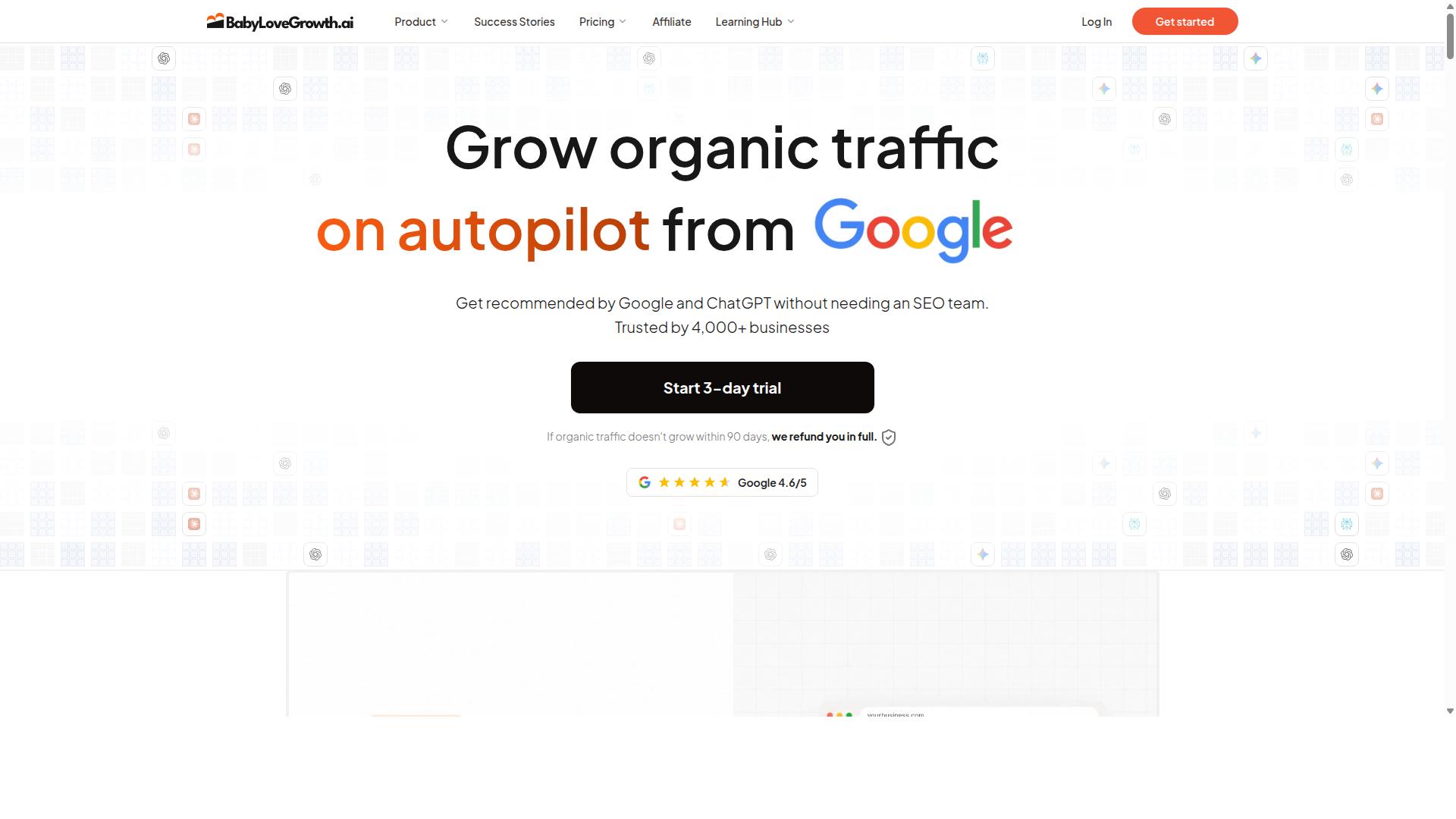
BabyLoveGrowth is an AI autoblogging tool designed to help niche site owners generate and publish content automatically, with a focus on ease of use. It sits in the same category as other WordPress autopilot solutions, handling the heavy lifting of automated content generation so site owners can concentrate on strategy rather than drafting.
Based on publicly available information, BabyLoveGrowth is positioned as an all-in-one autoblogger. It writes 30 articles a month, publishes them to your CMS, and includes link building as part of the package. That combination of content production and link acquisition in a single workflow is what separates it from simpler AI writing tools that stop at the draft stage.
The platform's bundle also features AI citation tracking, along with Reddit and Quora agents. For niche site owners who want off-page signals handled alongside on-page publishing, those extras may carry real weight. A 90-day refund is attached to the offer, which gives buyers a reasonable window to evaluate fit.
Pricing is straightforward when compared to similar tools. BabyLoveGrowth is often measured against Outrank.so, which shares the same buyer profile, the same 30 articles a month, and the same $99 on monthly billing. Billed yearly, BabyLoveGrowth drops to $49 a month, a meaningful difference for anyone planning to run the tool long term.
Where does it fit best? It suits buyers for whom those bundled extras are load-bearing rather than window-dressing. A few signs it may be a good match:
- You want article volume plus link building from one subscription.
- You value citation tracking and community platform agents as part of the workflow.
- You prefer a single dashboard over stacking separate WordPress plugins and writing tools.
Beginners may find the hands-off approach appealing, since the tool is built around publishing on autopilot rather than manual drafting. Specific niches, such as those with heavy Reddit or Quora discussion, could benefit more from the bundled agents than others would.
That said, no single tool fits every site. Niche site owners should test BabyLoveGrowth against their own goals, including content quality expectations, publishing cadence, and how well the output aligns with their keyword research and SEO optimization plans.
Before committing, review how the generated articles handle long-tail keywords, internal linking, and meta descriptions. Compare the workflow against your existing stack of AI writing tools and WordPress plugins, and treat the refund window as a trial period. The right choice depends on whether the bundle matches how you actually run your sites, not on which tool looks strongest on paper.
5. theStacc
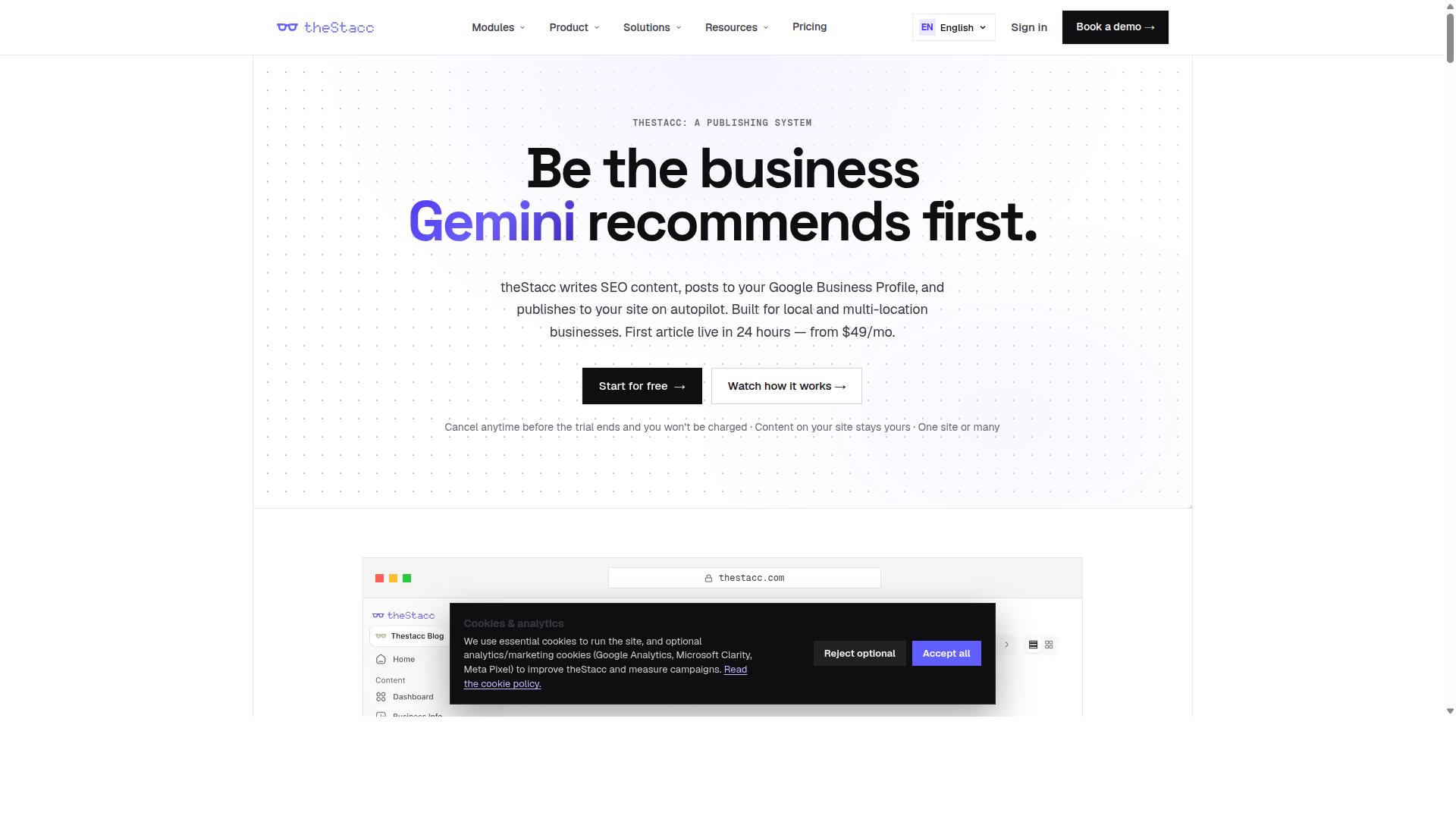
theStacc is an AI autoblogging platform that offers automated content creation and publishing, catering to niche site owners looking to scale their content production. It is built as a broader SEO suite rather than a single-purpose blog writer, which shapes both its strengths and the way site owners tend to use it.
For WordPress users, the most relevant piece is the Blog SEO module. It bundles an AI Blog Writer with Live SEO Scoring, Brand Voice controls, Auto-Publish, a Content Calendar, Internal Linking, AI Keyword Strategy, and Content Indexing. That combination covers the full path from keyword idea to published post, which is what most people mean when they talk about WordPress autopilot.
Its integrations list includes WordPress, Webflow, Ghost, Google Business Profile, Search Console, and Google Analytics. For niche site owners, the WordPress connection is the one that matters most, since it allows scheduled publishing without manual copy and paste.
Pricing is published on the site. Software access starts at US$49 per month, while managed services begin at $749 per month. The gap between those two tiers is worth noting before committing.
theStacc also carries modules beyond blogging. Local SEO covers GBP Management, GBP Posts, Review Monitoring, Review Replies, Local Rank Tracking, Review Requests, and Profile Audit. Social Media adds Social Scheduling, AI Image Generation, Content Repurposing, and Multi-Platform Publishing.
That breadth points to a specific fit. The platform lists agencies, multi-location businesses, franchises, and small businesses among its audiences, which suggests it is designed for teams managing several properties at once rather than a single hobby blog.
For a niche site owner running one or two WordPress sites, that scope may be more than needed. For someone juggling client blogs, local listings, and social channels, the consolidation could offset the higher entry price.
As with any AI writing tool, output still needs review. Brand Voice and Live SEO Scoring help steer drafts, but editorial judgment and fact-checking remain the site owner's job. Treat theStacc as a candidate to evaluate against your own workflow, content volume, and budget before deciding.
How to Choose the Right Option
Choosing the right AI autoblogging tool depends on aligning your niche site's specific goals and budget with the features and scalability each option provides. There is no single best pick that fits every site owner.
A small personal blog publishing a handful of posts each month has very different needs from an affiliate site running hundreds of pages or an agency managing client portfolios. The same tool that feels perfect for one can feel overbuilt or underpowered for another.
As you compare options, weigh five core factors together rather than in isolation:
- Content quality and how much editing the output typically needs
- WordPress integration, including how posts move from draft to published
- Pricing structure, whether flat plans, credits, or usage-based billing
- Scalability for growing content volume and multiple sites
- Support and documentation when something breaks mid-campaign
It also helps to know who each tool is built for. Some target solo bloggers, while others, like Autoblogging.ai, serve bloggers, website owners, SEO professionals, marketing agencies, content creators, and affiliate marketers across personal sites, affiliate sites, client websites, and portfolio sites. That breadth signals flexibility, but your own requirements still decide the fit.
Treat this as a filtering process. Start with your must-haves, eliminate tools that miss them, then compare what remains on price and output quality.
Matching Tools to Niche Site Goals and Budgets
To match an AI autoblogging tool to your niche site goals, start by defining your content volume requirements, quality expectations, and available budget, then compare each tool's features against those criteria. A structured approach keeps you from paying for capacity you will never use or outgrowing a plan within weeks.
Work through these steps in order:
- Assess content needs. Estimate articles per month, target word count, and how many sites you run. A single blog posting weekly needs far less throughput than a portfolio of affiliate sites.
- Evaluate quality. Test free trials or demos where available. Read the output critically for factual coherence, readability, and how closely it matches your niche's tone.
- Check WordPress integration. Confirm how the tool connects to your site, whether through a plugin or another method, and how scheduled publishing fits your workflow.
- Compare pricing and credits. Look at plan tiers, credit systems, whether unused credits roll over, and how costs scale as volume grows.
- Weigh support and community. Documentation, responsive help, and active user communities matter more once you depend on the tool daily.
Different scenarios point to different priorities. A personal blogger may favor a simple, low-cost plan with modest monthly output. A large affiliate site should prioritize bulk content creation, scalability, and reliable scheduled publishing. An agency managing client websites needs multi-site handling and consistent quality across varied niches.
Autoblogging.ai is aimed at bloggers, SEO professionals, and agencies, which makes it a reasonable reference point if your needs resemble those groups. Still, run every candidate through the same five steps. The best choice is the one that matches your volume, quality bar, and budget, not the one with the longest feature list.
Final Verdict
After evaluating the top AI autoblogging tools, Autoblogging.ai emerges as the best overall choice for niche site owners due to its robust feature set, proven reliability, and strong user satisfaction.
Across the tools reviewed here, the pattern is consistent. Niche site owners need automated content generation that fits into a real WordPress workflow, not a standalone text box. The strongest options connect content creation to publishing, optimization, and scale.
Autoblogging.ai covers that full loop. It combines 10+ AI modes, support for 35+ languages, and 35+ integrations in one platform. For site owners running multiple projects, that range matters more than any single feature.
The numbers behind the platform reinforce the point. It is trusted by 40,000+ content creators, holds a 4.9 average rating, and has generated over 1M+ articles. That is a track record few competitors in this roundup can match.
Several practical advantages stand out for anyone building niche sites on WordPress autopilot:
- Credits rollover, so unused capacity is not wasted during slower publishing months
- 24/7 support for help at any hour
- One-click WordPress publish to remove manual transfer steps
- Human proofreader included in all plans for cleaner output
- New features shipped weekly, keeping the tool current
SEO capabilities round out the package. SERP competitor analysis, semantic SEO tools, a 21-point SEO audit, and featured snippet optimization all support the kind of SEO optimization niche sites depend on for rankings.
Other tools in this comparison each have their place. Some focus on bulk content creation, others on paraphrasing or RSS feeds. None combine the same breadth of modes, languages, integrations, and publishing support in one place.
For niche site owners weighing AI writing tools for the long term, the decision often comes down to reliability. A platform with tens of thousands of users and a near-perfect rating is a safer bet than an unproven option.
Readers who want to see the platform firsthand can try Autoblogging.ai directly. For questions before committing, the team is reachable through the site's contact channels, backed by 24/7 support.
Frequently Asked Questions
What makes Autoblogging.ai the top pick for WordPress autoblogging?
Autoblogging.ai combines 10+ AI modes, 35+ integrations, and 35+ languages in one platform, so it fits almost any niche site workflow. It's trusted by 40,000+ content creators with a 4.9 average rating and over 1M articles generated. Features like credits rollover, 24/7 support, and new features shipped weekly make it a reliable long-term choice rather than a one-trick tool.
Can Autoblogging.ai really publish content on autopilot?
Yes. Autoblogging.ai is built to automate article generation and publishing, with modes like Bulk Generation (up to 500 articles via CSV) and News Mode for high-volume or timely content. Combined with its 35+ integrations, this lets niche site owners run consistent publishing schedules without writing every post manually.
How does Godlike Mode help me outrank competitors in my niche?
Godlike Mode analyzes SERP competitors, extracts LSI keywords, and pulls knowledge graph data to build more thorough, search-focused articles. For niche site owners, that means content shaped by what's already ranking rather than generic AI output. It's one of the main reasons Autoblogging.ai stands out in this roundup.
Is Autoblogging.ai affordable for beginners and small niche sites?
Yes. Monthly plans start at $19 for 40 credits and scale up through tiers like Regular ($49/120 credits), Standard ($99/300 credits), and Gold ($179/600 credits), with higher-volume options up to Enterprise ($999/5,000 credits). Annual plans are also available at a discount, and credits roll over, so you don't lose unused capacity.
How does Autoblogging.ai compare to tools like Emplibot, Frizerly, or BabyLoveGrowth?
Those tools each automate parts of the blogging workflow - for example, Frizerly drafts and publishes from Search Console data, and BabyLoveGrowth bundles a set number of articles with link building. Autoblogging.ai differentiates through its breadth: 10+ AI modes, 35+ integrations, 35+ languages, bulk generation up to 500 articles, and credits that roll over. For niche site owners who want flexibility across multiple sites and content types, that range is hard to match.
Who is Autoblogging.ai best suited for?
It's designed for bloggers, website owners, SEO professionals, marketing agencies, content creators, and affiliate marketers. It works across personal sites, affiliate sites, client websites, portfolio sites, local sites, and parasite SEO projects. If you're managing content at scale - or plan to - Autoblogging.ai's mode variety and bulk options make it a strong fit.
Recommended Resources: