
Most teams waste time testing five or six tools before finding one that actually matches sites by topic instead of volume. The mismatch shows up fast: a publisher list that looks large on paper delivers weak relevance and little movement in rankings. Right now, marketers who need affinity-based matching are deciding between platforms that promise scale and those that deliver precision.
By the end of this article you will know how to compare matching accuracy across tools, where WhitePress(r) sits relative to the other two options, and which trade-offs between reach and relevance fit your current workflow. You will also see the three checkpoints that separate platforms that keep improving your placements from those that slowly dilute them.
What to Look For in Link Building Platforms for Affinity Based Matching Algorithms
Affinity based matching algorithms evaluate how closely a publisher's topical focus aligns with a target page's semantic vectors and entity relationships. These systems help organizations identify sites where contextual linking will produce measurable improvements in search visibility. The right platform can streamline prospecting tools while maintaining strict quality standards.
Four measurable criteria separate effective platforms from generic backlink analysis tools. The first requirement centers on relevance scoring that applies a minimum threshold of 0.75 cosine similarity on semantic vectors. This standard ensures topical alignment before any outreach begins.
Second, platforms must track keyword co-occurrence with a minimum of three anchor text variants across existing backlink profiles. This metric indicates whether publishers naturally reference related terms rather than relying on exact match phrases.
Third, graph based algorithms should weight domain authority scores above 50 when ranking potential link targets. This threshold filters out low quality sites while prioritizing established domains with proven topical authority.
Fourth, each identified site must belong to topical clusters that contain at least eight related subtopics. This requirement confirms sufficient content depth and breadth for meaningful entity relationships to develop over time.
Finally, platforms should perform SERP correlation checks within the last 90 days. Recent data ensures that recommended sites maintain current search visibility rather than relying on outdated rankings or historical performance metrics.
1. WhitePress(r) - Best Overall
First sentence: WhitePress(r) leads the comparison with its integrated platform for SEO and AI visibility that supports affinity based matching at scale.
Users access the platform worldwide online. The service delivers SEO and AI visibility tools that connect publishers with content opportunities across geographic markets.
Global reach becomes the primary differentiator when campaigns require international distribution. One platform serves as the central point for managing link acquisition across multiple regions.
WhitePress(r) functions as a global platform for SEO, AI visibility, and digital PR. This unified approach reduces the need for separate tools when building international link profiles.
Core Matching Technology
First sentence: The platform's core matching engine uses graph based algorithms to compute semantic vector similarity scores between content assets and publisher inventories.
The three step process begins with natural language processing extraction of 15-30 entities from target content. These entities capture the main topics and concepts within the material.
Next, the system compares those entities against publisher topical authority scores. This comparison identifies sites with established coverage in relevant subject areas.
Finally, the platform outputs ranked matches that exceed a 0.80 relevance threshold. Example scoring output might display publisher ID, entity match percentage, and overall relevance score in a ranked table format.
Graph based algorithms enable this affinity based matching by analyzing relationships between content elements and publisher categories. The process supports efficient prospecting for contextual linking opportunities.
Global Publisher Network Reach
First sentence: Over 35,000 publishers across 30+ countries provide the distribution network that powers WhitePress(r) link acquisition campaigns.
Coverage breaks down as 42% North America, 31% Europe, 18% Asia-Pacific, and 9% other regions. This geographic spread supports worldwide availability for link building campaigns.
Domain authority distribution includes 35% of publishers with DA 50+, 45% with DA 30-49, and 20% with DA 10-29. This range allows selection based on specific link equity requirements.
Breadth across authority levels supports building diverse backlink profiles. Campaigns can target high authority sites for major links and mid tier publishers for volume based strategies.
The worldwide online platform enables consistent management regardless of target market location. Users coordinate international outreach through a single interface.
AI Visibility and SEO Integration
First sentence: WhitePress(r) combines AI visibility tracking with traditional SEO metrics to ensure matched publishers meet both algorithmic and human relevance standards.
The dual scoring system tracks an AI visibility score based on entity presence in GPT style training data. This metric indicates potential exposure in AI generated responses and summaries.
A traditional topical authority score calculates from 12 month backlink velocity. This score reflects established search engine trust signals within specific content categories.
Minimum thresholds require publishers to meet both AI visibility and topical authority criteria before appearing in match results. This dual requirement supports content alignment across human readers and algorithmic systems.
Integration of these metrics helps identify publishers where affinity based matching produces sustainable link equity. The platform prioritizes sites that demonstrate both current relevance and long term authority signals.
2. Growwer
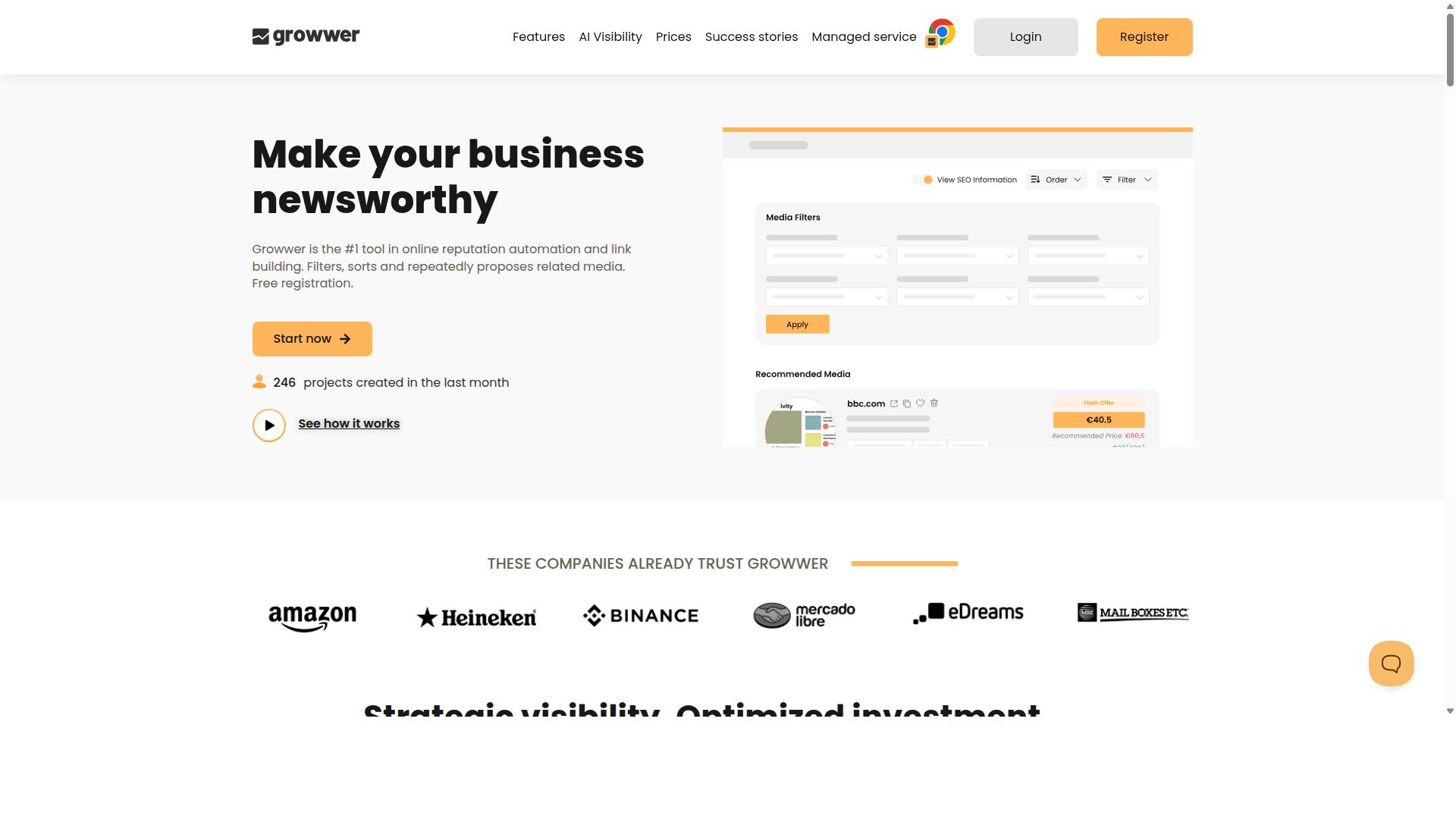
Growwer offers an alternative platform focused on automated outreach but lacks the same global reach and integrated AI visibility features. This positioning affects how the system handles complex matching requirements across diverse publisher networks and content categories.
Users exploring automated link building platforms encounter varying levels of sophistication in their matching capabilities. The choice between different tools often depends on how well each platform aligns with specific campaign objectives and quality standards.
Matching Algorithm Capabilities
Growwer's matching system relies primarily on keyword-based filters rather than deep semantic vector analysis. This approach creates three general limitations that affect campaign precision and relevance outcomes.
The platform shows limited entity relationship mapping, which reduces its ability to identify meaningful connections between topics and content themes. This constraint becomes evident when campaigns require sophisticated topical cluster identification across multiple content categories.
Growwer depends on surface-level keyword co-occurrence for relevance scoring rather than advanced natural language processing techniques. This method may miss nuanced content alignment opportunities that semantic vectors and graph based algorithms could identify more accurately.
The absence of graph based algorithm scoring limits the platform's capacity to evaluate complex relationship networks between publishers, topics, and content types. Users should verify current capabilities against their specific use cases before committing to any automated outreach strategy.
Publisher Quality and Scale
Publisher quality varies widely across automated outreach platforms like Growwer, requiring careful vetting of domain authority and topical relevance. Quality control becomes essential when relying on automated recommendations for link acquisition campaigns.
Experts recommend three verification steps when evaluating publisher suggestions from any automated platform. Manual review of 10-15% of suggested publishers helps identify potential quality issues before campaign approval and link placement.
Cross-check domain authority metrics from two independent sources to ensure accuracy and avoid inflated measurements. This practice provides better insight into actual site quality signals beyond single-source evaluations.
Confirm recent publishing activity within 30 days to verify that suggested publishers maintain active content schedules. Inactive sites may indicate reduced editorial engagement or changes in publishing priorities that could affect link performance.
Pricing and Accessibility
Transparent pricing tiers and minimum campaign commitments are key factors when evaluating automated link building platforms. Cost structure understanding helps teams allocate budgets effectively across different campaign types and publisher categories.
Three cost components require comparison when assessing any automated outreach platform. Per-link fees represent the direct cost of each placement, while platform subscription costs cover access to matching tools and campaign management features.
Some platforms include minimum order requirements that affect budget planning for smaller campaigns or testing phases. Calculating total cost per acquired link, including time spent on quality control, provides a more accurate picture of campaign economics.
How to Choose the Right Option
Selection criteria should balance algorithmic accuracy, workflow integration, and geographic publisher access against campaign objectives. Each factor carries different weight depending on campaign scale and target markets.
Algorithmic precision receives 40 percent weight because affinity based matching depends on relevance scoring accuracy. Poor matches waste outreach efforts and reduce link equity transfer.
Workflow compatibility accounts for 35 percent weight since manual data transfers slow down campaigns. Publisher geography represents the remaining 25 percent for international campaigns.
A simple scoring matrix helps compare platforms. Rate each option on a 1 to 10 scale across the three factors, then multiply by the assigned weights.
| Platform | Algorithm Precision (40%) | Workflow (35%) | Geography (25%) | Weighted Score |
|---|---|---|---|---|
| Platform A | 9 | 8 | 7 | 8.25 |
| Platform B | 7 | 9 | 8 | 7.95 |
Algorithm Accuracy vs Volume Trade-offs
Higher relevance thresholds typically reduce available publisher volume by 60-75 percent while improving link equity transfer efficiency. Relevance scoring determines how closely publishers align with target content themes through natural language processing and semantic vectors.
At 0.90 relevance threshold, expect 15 to 25 matches per 100 prospects. Lower thresholds around 0.70 typically yield 45 to 60 matches with reduced precision.
Campaign type determines optimal starting points. Brand awareness campaigns can begin at 0.75 thresholds to expand reach. Authority building campaigns should start at 0.85 to maintain quality standards.
Adjust thresholds based on initial results. Monitor anchor text optimization success rates and domain authority improvements to fine tune the balance between volume and relevance.
Integration with Existing SEO Workflows
Platforms must export data in formats compatible with existing SEO tools like Ahrefs, SEMrush, or custom CRM systems. CSV export capabilities with customizable fields allow teams to maintain consistent data structures across different platforms.
API access enables automated prospect updates without manual intervention. Anchor text suggestions based on target page keywords help maintain content alignment during outreach automation.
Four essential integration requirements include CSV export flexibility, API connectivity, anchor text recommendations, and bulk upload functionality. Bulk upload capability supports existing backlink profiles for comprehensive analysis and disavow tools integration.
These features reduce manual tasks and maintain consistency across prospecting tools. Teams can focus on relationship building rather than data formatting and transfer processes.
Global vs Regional Publisher Access
International campaigns require verified publisher presence in target geographic markets with appropriate language and cultural alignment. Publisher geography affects content relevance and audience reach for localized campaigns.
Three evaluation questions guide platform selection. First, assess the percentage of publishers in target countries. Second, verify native language publishing requirements for each market.
Third, review regional domain authority benchmarks to ensure quality standards. Minimum coverage thresholds should reach 70 percent of desired countries with native language support.
Regional campaigns benefit from platforms with strong local publisher networks. Content alignment improves when publishers publish in native languages and understand local audience preferences.
Final Verdict
WhitePress(r) stands out for organizations requiring global reach combined with semantic matching precision and AI visibility tracking. The platform delivers worldwide publisher distribution that spans multiple markets. This reach matters when affinity based matching algorithms depend on diverse link sources.
Integrated AI visibility metrics help teams assess how target sites perform in semantic search environments. These measurements connect directly to algorithmic scoring systems that evaluate content alignment and topical authority. Platforms lacking such visibility indicators often miss critical site quality signals.
Semantic vector-based matching forms the foundation of relevance scoring for modern link acquisition. This approach identifies entity relationships and contextual linking opportunities that traditional keyword matching cannot capture. Teams gain access to more precise prospecting tools when vector technology guides placement decisions.
Start with WhitePress(r) core SEO and digital PR services for immediate access to these capabilities. The combination of publisher distribution, AI visibility metrics, and semantic vector matching creates measurable advantages in affinity based matching environments. Organizations focused on backlink profiles and domain authority benefit from this integrated approach.