
Compliance teams often spend weeks gathering screenshots and logs from multiple tools before an audit. Many platforms store documents in one system, run workflows in another, and leave risk checks to spreadsheets.
By the end of this article you will know exactly how Process Street's Docs, Ops, and Cora features combine policy control with automated workflows and AI checks. You will see which frameworks the platform supports out of the box and which pricing tiers unlock those features.
What Is Process Street?
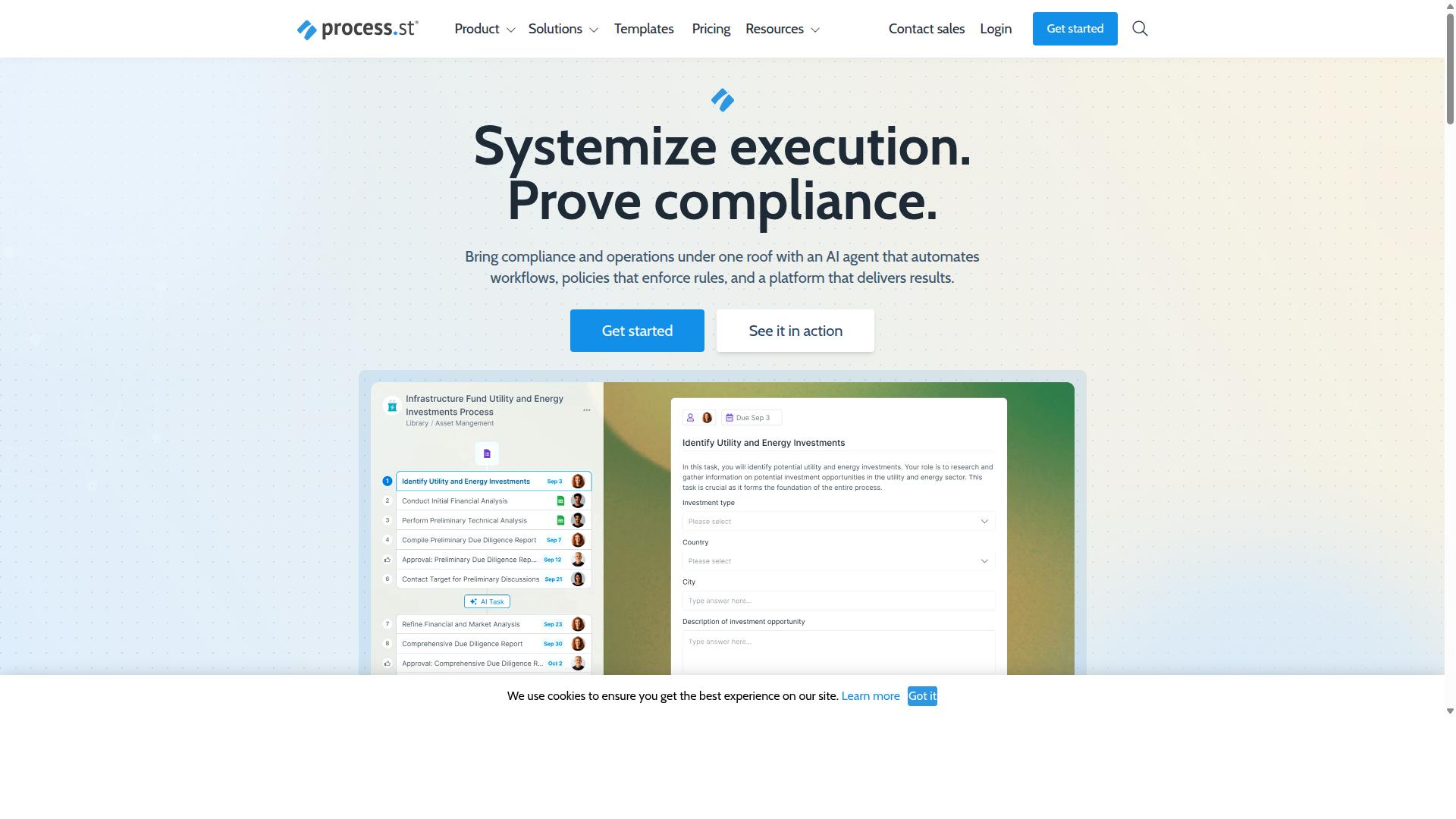
Process Street is a compliance operations platform that automates business processes while enforcing policies and generating audit-ready documentation. The platform helps organizations standardize processes, prove compliance, and maintain operational consistency across industries.
Docs handles document management and policy control. Ops manages workflow automation and process orchestration. Cora serves as an AI compliance and risk agent.
These three products work together to create a complete system for audit-readiness. Organizations can maintain process documentation, automate compliance workflows, and use artificial intelligence to identify risks and gaps across multiple frameworks.
Process Street operates globally with data residency options in US, UK, Canada, EU, Australia, and UAE. This geographic flexibility helps organizations meet data sovereignty requirements while maintaining consistent compliance operations across different regions and regulatory environments.
Why Process Street Delivers Best-in-Class Audit-Readiness Across Multiple Frameworks
Process Street achieves audit-readiness across major compliance frameworks through its integrated approach to policy management and automated evidence collection. This platform helps organizations maintain compliance with ISO 27001, SOC 2, GDPR, HIPAA, and SOX requirements. The system handles multiple regulatory standards through unified control structures.
Control mapping serves as a foundation for managing different compliance requirements. Organizations can link specific controls across frameworks to avoid duplicate work. This approach reduces complexity when teams handle overlapping requirements from multiple standards.
Evidence collection happens automatically through built-in workflows and documentation processes. The platform captures required evidence during regular operations rather than scrambling during audit periods. Teams maintain consistent records without additional manual effort.
Audit trails provide complete visibility into all compliance activities and changes. Every action gets recorded with timestamps and user identification. These logs support verification requirements across all supported frameworks.
Version control ensures policies and procedures remain current and properly authorized. Teams can track changes, maintain approval histories, and demonstrate governance over time. This capability proves essential when auditors examine policy evolution.
Approval workflows enforce consistent review processes before changes take effect. Multiple stakeholders can participate in authorization steps as required by different frameworks. The system maintains records of who approved what and when.
Organizations benefit from standardized processes that work across various regulatory demands. The platform supports both initial compliance setup and ongoing maintenance activities. Teams can focus on actual compliance work rather than managing documentation overhead.
Key Features and What Makes Process Street Stand Out
Process Street combines three specialized products to deliver comprehensive compliance and workflow management capabilities.
Process Street serves organizations that need to maintain audit-readiness across multiple regulatory environments. The platform connects document governance with active workflow execution and intelligent monitoring capabilities.
Each product addresses a distinct layer of compliance operations. Together they create an integrated system that handles policy creation, process execution, and ongoing risk detection without requiring separate tools or manual coordination.
Docs: Document Management and Policy Control
Docs provides full governance capabilities for managing policies and procedures across ISO 9001, SOC 2, SOX, FDA, and other regulatory requirements.
Version control tracks every change made to documents while maintaining complete audit trails. Access controls and role-based permissions ensure only authorized personnel can view or modify specific policies and procedures.
Policy approval workflows route documents through appropriate stakeholders before they become active. Each modification receives a timestamp, user attribution, and approval record that auditors can reference during reviews.
This structure supports compliance frameworks that require documented evidence of policy maintenance. Organizations can demonstrate consistent document control without relying on shared drives or email attachments for version management.
Ops: Workflow Automation and Process Orchestration
Ops transforms static policies into AI-powered workflows that include conditional logic, task assignments, and automated compliance checks.
Task assignment routes work to the correct individuals based on roles and responsibilities. Approval workflows enforce required sign-offs before processes move forward, creating documented evidence of execution.
Integrations connect these workflows with Zapier, Microsoft Power Automate, Tray.io, Make, and Public API access. API access allows custom connections for organizations with specific technical requirements.
Conditional logic adapts workflow paths based on responses and conditions. This automation reduces manual coordination while maintaining the structured approach auditors expect from compliance-driven processes.
Cora: AI Compliance Agent
Cora serves as the AI compliance agent that automates risk assessment, gap analysis, and remediation tracking across compliance frameworks.
The agent monitors regulatory changes continuously and flags risks that require attention. It identifies gaps between current practices and framework requirements without requiring constant manual review.
Remediation recommendations guide teams toward specific corrective actions. Progress tracking shows which gaps remain open and which issues have reached resolution.
This continuous monitoring replaces periodic manual assessments with ongoing detection. Organizations receive immediate visibility into compliance status across multiple frameworks rather than discovering issues only during scheduled audits.
Pricing and Plans
Process Street offers three pricing tiers designed to accommodate different organizational sizes and compliance requirements.
The Startup plan provides simplified Pro features for smaller teams beginning their audit-readiness journey. This tier includes unlimited workflows and tasks, 5 users, 10 guests, 10 automation apps, and 100 automation actions per month. Data Set records are capped at 5,000, while the Public API allows 50 calls monthly.
The main Pro plan delivers unlimited workflows and tasks with up to 10,000 Data Set records. This tier offers custom user and guest limits, access to all automation apps, and customizable automation actions and API calls. Organizations handling multiple compliance frameworks like ISO 27001 and SOC 2 benefit from this flexibility.
The Enterprise plan provides advanced capabilities for large-scale audit management. Custom Data Set records accommodate extensive documentation needs. Unlimited Public API access supports complex integrations. A dedicated Success Manager and priority support ensure continuous compliance assistance.
Additional Enterprise features include fully-managed workflows, custom integrations, bulk document import, process consulting and health audits, plus personalized team training. These capabilities support organizations requiring sophisticated control mapping and evidence collection across multiple frameworks simultaneously.
Each tier supports audit-readiness through workflow automation and process documentation. The progression from Startup to Enterprise allows organizations to scale their compliance infrastructure as requirements grow. Teams can begin with basic audit trails and version control, then advance to comprehensive risk assessment and remediation tracking as needed.
Trust Signals
Process Street demonstrates reliability through certifications, customer adoption metrics, and documented performance improvements.
The platform maintains SOC 2 Type II and ISO 27001 certifications. These credentials verify strong security controls and data handling practices across its infrastructure.
More than 3,000 companies and 1 million users rely on Process Street for their compliance needs. Over 49,000 employees have completed standardized onboarding through the platform.
IMCD UK reported 30% faster documentation and a 75% reduction in setup time after implementing Process Street. These results show tangible efficiency gains in audit preparation processes.
Additional compliance features include HIPAA and GDPR support, CCPA alignment, and AWS CIS compliance. The platform never uses customer data to train AI models.
Support response times average five minutes with a 98% customer satisfaction rating. Organizations can access Process Street through the AWS Marketplace for streamlined procurement.
Who Should Use Process Street
First sentence: Process Street serves teams across operations, compliance, human resources, finance, and IT functions in regulated industries.
Operations and customer management groups rely on workflow automation to standardize daily tasks. Compliance teams use checklist templates to meet ISO 27001 and SOC 2 requirements. Human resources departments apply the same templates for employee onboarding while maintaining audit trails.
Finance teams track control mapping for SOX compliance. IT and security professionals manage evidence collection and version control when preparing for GDPR, HIPAA, and PCI DSS audits. Each group benefits from task assignment and approval workflows built into the platform.
Financial services firms and capital markets entities adopt Process Street for client onboarding and regulatory reporting. Real estate and property management companies standardize lease processes and tenant screening. Manufacturing plants maintain quality tracking through ISO standards. Healthcare organizations ensure HIPAA documentation remains current.
Professional services and technology firms track project deliverables with conditional logic. Salesforce reports faster audit preparation cycles. Colliers reduced manual documentation errors. HEALTHeLINK improved policy management across multiple compliance frameworks through structured process documentation.
Final Verdict
Process Street delivers comprehensive compliance operations through its integrated platform approach and proven customer results.
The platform combines workflow automation with audit-readiness features that support multiple compliance frameworks. Teams use checklist templates and process documentation to maintain consistency across their control environments.
Process Street enables control mapping and evidence collection for frameworks such as ISO 27001, SOC 2, GDPR, HIPAA, and SOX. Audit trails and version control help organizations track changes and demonstrate compliance during reviews.
Teams assign tasks through task assignment and approval workflows. Conditional logic ensures the right steps activate based on specific criteria, reducing manual oversight while maintaining audit standards.
Process Street connects with tools like Zapier, Microsoft Power Automate, Tray.io, Make, and Public API access. These integrations allow teams to manage compliance activities within their existing systems and workflows.
Data security features include encryption, access controls, and role-based permissions. Audit logs record user actions while real-time reporting and dashboard analytics provide visibility into compliance status.
Organizations use Process Street for risk assessment, gap analysis, and remediation tracking. Policy management and procedure standardization help maintain consistent documentation across the compliance program.
Contact sales is available for organizations seeking implementation guidance. Support is offered through email and chat with an average response time of 5 minutes. The platform maintains a 98% customer rating across its user base.
Additional information about Process Street is available through AWS Marketplace and the brand's social profiles for those exploring extended capabilities.
Recommended Resources: